
Visa Service
Non-B Visa
What is a Non-Immigrant B Visa (Business Visa)?

The Non-Immigrant B Visa (Non-B) is designed for foreign nationals intending to legally work or conduct business in Thailand. This visa serves as the primary prerequisite for obtaining a Work Permit issued by the Department of Employment and facilitates long-term residency under the oversight of the Thai Immigration Bureau.
Who is this visa for:
The Non-Immigrant B visa is suitable for professionals including:
- Corporate Employees: Individuals employed by a Thai company.
- Executives and Directors: Those serving in management or board positions within a Thai entity.
- Specialists: Skilled professionals, such as engineers, teachers, or software developers.
- Entrepreneurs: Individuals establishing or operating their own businesses in Thailand.
In the standard application process, the hiring Thai company serves as the “visa sponsor,” responsible for providing the necessary employment certification documents.
Important Note: Upon receiving the Non-B visa, you must secure your official Work Permit before commencing any employment activities in the country.
Additional Information
✅ Non-B Visas are not permanent. Initially, holders are granted a 90-day stay, which can subsequently be extended to 1 year upon obtaining a Work Permit.
✅ Working on a Tourist Visa is strictly prohibited. This includes remote work or working from home. Any individual residing in Thailand and earning an income must possess a legally valid visa.
✅ The Non-B Visa serves as a gateway to long-term residency. Non-B Visa holders are eligible to:
- Apply for annual extensions.
- Obtain Dependent Visas (Non-O) for family members.
- Utilize the visa as a foundation for applying for Permanent Residency in the future (subject to eligibility requirements).
Visa Service
Key Requirements for Non-B Visa Application

1. Sponsorship by a Thai Employer or Company is Required
This means the applicant must have a company in Thailand issue a letter of employment certification. A Non-B Visa cannot be obtained without a supporting company.
2. The Company Must Be Legally Registered The company must:
- Be registered with the Department of Business Development (DBD).
- Have a valid Juridical Person Registration Number.
- Possess audited financial statements and active business operations.
- Meet the registered capital requirements as prescribed by law (generally 2 million THB per foreign employee).
3. A Work Permit Must Be Obtained Before Commencing Work
Even with a Non-B Visa, working is strictly prohibited until a Work Permit is issued by the Department of Employment. Engaging in work that does not match the details specified in the permit is considered illegal. The Work Permit will specify:
- Job Title/Position
- Company Name
- Work Location
4. 90-Day Reporting is Mandatory
Non-B Visa holders must report their current address to the Immigration Bureau every 90 days. This can be done via:
- In-person submission.
- Authorized representative (Power of Attorney).
- Online submission (in certain cases).
Visa Service
Required Documents for Non-B Visa Application
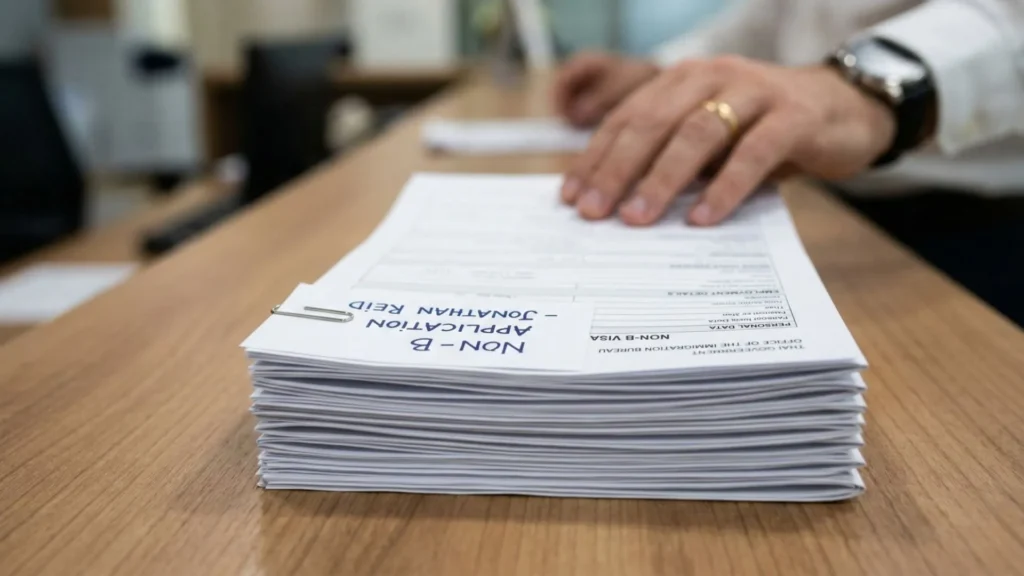
Applicant’s Documents
Passport: Must have a remaining validity of at least 6 months and contain blank pages for the visa stamp.
Photographs: Dimensions as specified (generally 4×6 cm), taken within the last 6 months.
Educational Certificates / Resume: Used to demonstrate that the applicant possesses qualifications or experience relevant to the position (e.g., a Bachelor’s degree in IT for a Programmer role) and professional licenses (if applicable).
Employment Contract: A formal agreement between the company and the applicant, specifying: Job Position / Salary / Duties and Responsibilities / Duration of Employment
Company’s Documents
Company Certificate (Affidavit): A document issued by the Department of Business Development to verify the company name, registered capital, and authorized directors.
P.P.20 (VAT Registration Certificate): A document proving the company is registered for Value Added Tax (VAT), confirming that the business is actively operating.
List of Shareholders (BOJ.5): Displays the shareholding proportions to verify that the company structure complies with Thai law.
Financial Statements: Displays the company’s financial performance, used to assess the stability and credibility of the business.
Company Map: Clearly identifies the business location; in some cases, authorities may conduct an on-site inspection.
Visa Service
Step-by-Step Process: Initial Application to 1-Year Extension (Non-B Visa + Work Permit)
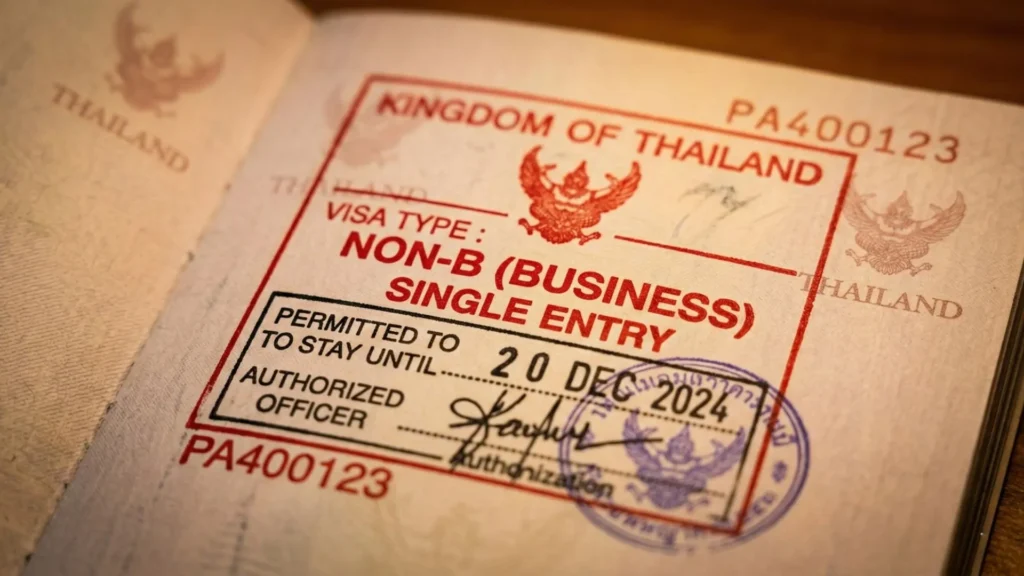
Step 1: Assessing Company Eligibility
- Legally registered with the Department of Business Development (DBD).
- Sufficient registered capital (generally 2 million THB per 1 foreign employee).
- At least 4 Thai employees per 1 foreign employee (for general cases, non-BOI).
Step 2: Preparing Documents for Non-B Visa Application
- The company issues an Employment Certification Letter.
- Prepare Corporate Documents (Company Certificate, P.P.20, List of Shareholders, etc.).
- Applicant prepares Passport, Educational Certificates, and Resume.
Submit the application via a Thai Embassy/Consulate abroad or apply for a Change of Visa Type within Thailand (in certain cases).
Initial 90-day stay is granted.
Step 3: Applying for a Work Permit
Submit the application to the Department of Employment.
- Application must be submitted before commencing work.
- The permit will clearly specify the job position, company, and work location.
Step 4: Extending the Visa to 1 Year
After obtaining the Work Permit, apply for an extension at the Immigration Bureau.
Key Documents:
- Work Permit
- Salary Slips / Tax Records
- Updated Corporate Documents
- Immigration Forms (TM.7)
Upon approval → 1-year stay is granted, with mandatory 90-day reporting required.
Minimum Monthly Salary by Nationality (General Guidelines)
Minimum rates required for Work Permit consideration and 1-year Visa extension:
| Nationality | Minimum Monthly Salary (THB) |
|---|---|
| Europe / USA / Australia | 50,000 THB |
| Japan | 50,000 HB |
| South Korea / Taiwan / Hong Kong / Singapore | 45,000 THB |
| Malaysia | 35,000 THB |
| India | 35,000–45,000 THB |
| China / Vietnam / Indonesia / Philippines | 35,000 THB |
| Myanmar / Laos / Cambodia | Based on Labor Category (Typically under the MOU System) |
Company Structure Suitable for Foreign Employment
1. Registered Capital
- At least 2 million THB per 1 foreign employee.
- If hiring 2 foreign employees → A minimum capital of 4 million THB is required.
2. Thai Employee Ratio
- Generally, 4 Thai employees per 1 foreign employee.
- All employees must be officially registered with the Social Security Office.
3. Revenue and Financial Statements
- The company must demonstrate active business operations and real revenue.
- Financial statements and taxes must be filed accurately and in compliance with the law.
4. Clear Job Position
- The position must not be a prohibited occupation for foreigners.
- The role must align with the applicant’s educational background and professional experience.
5. Special Cases (BOI)
If a company is promoted by the Board of Investment (BOI), it offers several advantages:
- Exemption from the 4:1 Thai-to-foreigner ratio.
- Expedited approval process.
- 1–2 year visa validity.
- Single Window System for visa and work permit services.
- Specific income certification requirements.